Terms & Techniques
Become an expert: (Dis)Information Terminology and Propaganda Techniques
truth, misinformation, disinformation, malinformation, propaganda, psy-ops, psychological warfare, active measures, reflexive control, hybrid warfare, firehose of falsehoods, weaponized narratives, FIMI, prebunking, debunking, NAFO

There is no such thing like Truth.
Propaganda tries to destroy our sense of truth and tries to mislead us in the interest of others.
Truth
The reason we focus on truths, not lies, we mark lies a such, and we immediately follow up lies with a short corrective truth, is this:
As Gilbert writes, human minds, “when faced with shortages of time, energy, or conclusive evidence, may fail to unaccept the ideas that they involuntarily accept during comprehension.” Trump’s Lies vs. Your Brain
In order to understand a lie, we need to have it in our short-term memory for a moment, if we get distracted before recognizing it as a lie, e.g. by the next lie, we risk to store a stream of lies in our long-term memory. This is the reason, Propagandists like Donald Trump or Sahra Wagenknecht spill, out a rapid stream of lies.
Desinformation
Misinformation is incorrect or misleading information (see Wikipedia).
Malinformation is correct information deliberately spread with malign intent (see Wikipedia).
Disinformation is misinformation deliberately spread to deceive people (see Wikipedia and German Government).
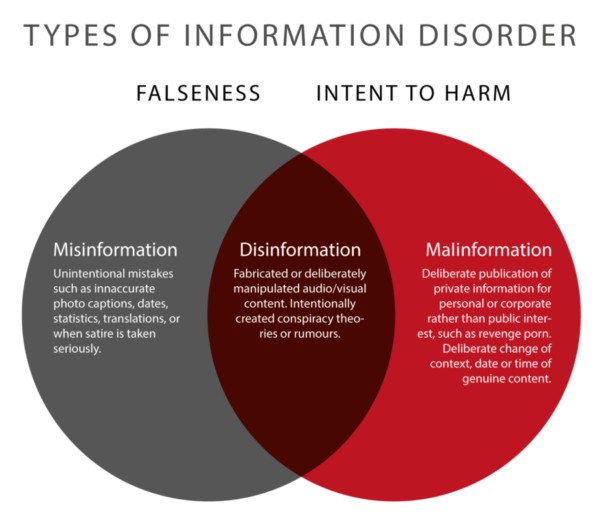
Disinformation can be information that is
- isolated: out of context
- framed: put into different context
- manipulated: e.g. tampered pictures
- invented: completely made up, e.g. prompted AI
Arguably the longest lasting disinformation was likley planted by the Czarist secret service Ochrana: “The Protocols of the Elders of Zion” - a deeply antisemitc pamphlet that is very popular among the far-right, parts of the far-left and islamists until today.
In Soviet times “Operation Denver” was launched in which the USSR spread the rumor that AIDS was an US-biological weapon. This should deflect attention from the use of chemical agents in Afghanistan and was partially successful in achieving the wanted outcome.
The four D developed by White (2016) describe elements of disinformation. Later this has been extended to the five D:
- Dismiss: defame the source, deny the information
- Distort: manipulate context and content, invent content
- Distract: Russia wants that our thinking and talking follows their agenda, or at least: not our own agenda. Even while we debunk their disinformation, we are distracted from the truth and out relevant preparations and actions.
- Dismay: daunt, threaten and terrorize (nuclear threat to trigger “German Angst”)
- Divide: Aikidō of disinformation, use the power of the enemy society to fight against itself (sponsor right-wing and left-wing to destabilize and to fuel political disputes)
Propaganda
Propaganda is communication that is primarily used to influence or persuade an audience to further an agenda, which may not be objective and may be selectively presenting facts to encourage a particular synthesis or perception, or using loaded language to produce an emotional rather than a rational response to the information that is being presented.[1] Propaganda can be found in a wide variety of different contexts. Wikipedia
War and hate propaganda has been banned since 1976. United Nation Treaties, Chapter IV, 4. INTERNATIONAL COVENANT ON CIVIL AND POLITICAL RIGHTS, Article 20 states:
- Any propaganda for war shall be prohibited by law.
- Any advocacy of national, racial or religious hatred that constitutes incitement to discrimination, hostility or violence shall be prohibited by law.
This treaty was signed 18 Mar 1968 and ratified 16 Oct 1973 by the Russian Federation.
The fascist manifesto “What Russia should do with Ukraine” published by the state news agency Ria Novosti violates Article 20, it
calls for the elimination of the Ukrainian elites and the “de-ukrainization” of the Ukrainian nation – even stripping Ukraine of its name, and destroying Ukrainian culture. Ukrainians are described in terms similar to the Nazi Untermenshen – subhuman, as the Nazis referred to non-Aryan “inferior people” such as “the masses from the East” – that is Jews, Roma, and Slavs.
This is pure fascism.
By publishing this story on April 3, the same day the world found out about horrible massacre of at least 400 Ukrainian civilians by the Russian army in Bucha, RIA Novosti has sunk to a level a cynicism not seen since the 1930s in Europe. This fascist manifesto lays bare the dreadful danger that the regime of Russian dictator Vladimir Putin now poses to Ukraine, and to the world.
Psychological warfare
Disinformation is part of psychological warfare. The term ‘psychological warfare’ is used “to denote any action which is practiced mainly by psychological methods with the aim of evoking a planned psychological reaction in other people” Wikipedia.
Note that psychological reactions like fear, frustration and hopelessness are created using a mix of disinformation, military and terrorist actions. Particularly brutal methods were brought by Genghis Khan to Moskow:
Genghis Khan, leader of the Mongolian Empire in the 13th century AD employed less subtle techniques. Defeating the will of the enemy before having to attack and reaching a consented settlement was preferable to facing his wrath. The Mongol generals demanded submission to the Khan and threatened the initially captured villages with complete destruction if they refused to surrender. If they had to fight to take the settlement, the Mongol generals fulfilled their threats and massacred the survivors. Tales of the encroaching horde spread to the next villages and created an aura of insecurity that undermined the possibility of future resistance. Wikipedia
Since then, Russian dictators use brutal psychological warfare to expand the Russian empire and to suppress their their own population.
Active Measures (1920)
Active measures (Russian: активные мероприятия, romanized: aktivnye meropriyatiya) is a term used to describe political warfare conducted by the Soviet Union and the Russian Federation. The term, which dates back to the 1920s, includes operations such as espionage, propaganda, sabotage and assassination, based on foreign policy objectives of the Soviet and Russian governments.Wikipedia
For more details see Galeotti (2019) Darczewska and Żochowski (2017)
Reflexive Control (1967)
Modern psychological warfare is a mixture of these brutal and more subtle methods. Soviet mathematical psychologist Vladimir Lefebvre developed the concept of Reflexive Control 1967 (Goeij (2023)). According to Kamphuis (2018), the elements of Reflexive Control are:
- Distraction: create a real or imaginary threat to the enemy’s flank or rear during the preparatory stages of combat operations, forcing him to adapt his plans.
- Overload (of information): frequently sent large amounts of conf licting information.
- Paralysis: create the perception of an unexpected threat to a vital interest or weak spot.
- Exhaustion: compel the enemy to undertake useless operations, forcing him to enter combat with reduced resources.
- Deception: force the enemy to relocate assets in reaction to an imaginary threat during the preparatory stages of combat.
- Division: convince actors to operate in opposition to coalition interests.
- Pacification: convince the enemy that preplanned operational training is occurring rather that preparations for combat operations.
- Deterrence: create the perception of superiority.
- Provocation: force the enemy to take action advantageous to one’s own side.
- Suggestion: offer information that affects the enemy legally, morally, ideologically, or in other areas.
- Pressure: offer information that discredits the enemy’s commanders and/or government in the eyes of the population.
For an empirical study on Reflexive Control in Russia’s war against Ukraine see Doroshenko and Lukito (2021). For a detailed study on Reflexive Control see Vasara (2020)
Hybrid Warfare (2007)
The term Hybrid war or hybrid warfare was established by Hoffman and Policy Studies (2007) and describes a flexible mixture of regular and irregular, symmetrical and asymmetrical, military and non-military means of conflict, used openly and covertly, with the aim of blurring the threshold between the binary states of war and peace as defined by international law.
The boundary to the perfidy prohibited by the Geneva Conventions is blurred.
The russian invasion of Crimea and the Donbas are clear examples of Hybrid Warfare: Russia sent soldiers without insignia, claiming that they were separatists, i.e. inner-ukrainian actors, and accompanied this with hate propaganda: The 2014 Report of the United Nations High Commissioner for Human Rights on the situation of human rights in Ukraine (Human Rights (2014)) found that Russia used hate propaganda violating article 20 during the invasion of Crimea:
New restrictions on free access to information came with the beginning of the Crimea crisis. Media monitors indicated a significant raise of propaganda on the television of the Russian Federation, which was building up in parallel to developments in and around Crimea. Cases of hate propaganda were also reported. Dmitri Kiselev, Russian journalist and recently- appointed Deputy General Director of the Russian State Television and Radio Broadcasting Company, while leading news on the TV Channel “Rossiya” has portrayed Ukraine as a “country overrun by violent fascists”, disguising information about Kyiv events, claimed that the Russians in Ukraine are seriously threatened and put in physical danger, thus justifying Crimea’s “return” to the Russian Federation.
Meanwhile, even the sluggish German foreign intelligence service, the BND, is beginning to recognize the danger of hybrid warfare (Spiegel (2026)):
Russia reportedly has up to 60,000 intelligence operatives at its disposal worldwide, “not to mention an even larger number of co-opted individuals—former military personnel, procurement assistants, and other proxies.” The Federal Criminal Police Office recorded 321 suspected cases of sabotage in 2025. “It is likely that Russian actors and their Telegram agents are behind many of these incidents.”
Information War (2016)
Edward Lucas and Peter Pomerantsev wrote a working paper on counterstrategies to Russian propaganda in Central and Eastern Europe. The report (Lucas and Pomerantsev (2016b)) and recommendations (Lucas and Pomerantsev (2016a)) were published in 2016 in partnership with the Information Warfare Initiative of the Center for European Policy Analysis (CEPA).
In an article linking many of her work, journalist Zarina Zabrisky, who was teached russian propaganda techniques at Pushkin Leningrad State University, stated (Zabrisky (2017)):
The main goal of spetz-propaganda is to cause confusion in the enemy’s population
For a recent (August 2025) deconstruction of Kremlin’s Information Warfare see Zabrisky (2025).
Firehose of Falsehoods (2016)
New Russian propaganda entertains, confuses and overwhelms the audience
According to Paul and Matthews (2016), the distinctive features of the Firehose of Falsehoods Model for Russian Propaganda are
- High-volume and multichannel (messages received in greater volume and from more sources will be more persuasive)
- Rapid, continuous, and repetitive (first impressions are very sticky, repetition leads to familiarity, and familiarity leads to acceptance)
- Lacks commitment to objective reality (fake evidence and other factors)
- Lacks commitment to consistency (not needed if distraction is the goal, not needed if the audience is not used to read longer texts, process longer thoughts)
Psychological studies show that when the brain is exposed to the same information continuously, it begins to perceive that information as true—regardless of conflicting or contrary evidence Disinformation and Reflexive Control: The New Cold War
This means that when the New York Times, or any other publication, runs a headline like “Trump Claims, With No Evidence, That ‘Millions of People Voted Illegally,’” it perversely reinforces the very claim it means to debunk. Trump’s Lies vs. Your Brain
When we are overwhelmed with false, or potentially false, statements, our brains pretty quickly become so overworked that we stop trying to sift through everything Trump’s Lies vs. Your Brain
Brendan Nyhan, a political scientist at Dartmouth University who studies false beliefs, has found that when false information is specifically political in nature, part of our political identity, it becomes almost impossible to correct lies. Trump’s Lies vs. Your Brain
In recent times there are many examples but as it just happened yesterday 10 years ago i will use the example of the shooting down of MH17 by Russian forces. After the event Russian propaganda went into overdrive and used the “Firehose of Falsehoods”.
Weaponized Narratives (2017)
The term Weaponized Narratives was introduced by B. R. Allenby (2017), B. Allenby and Garreau (2017). According to The Weaponized Narrative Initiative at The Center on the Future of War:
Weaponized narrative is an attack that seeks to undermine an opponent’s civilization, identity, and will. By generating confusion, complexity, and political and social schisms, it confounds response on the part of the defender.
How Does Weaponized Narrative Work? A fast-moving information deluge is the ideal battleground for this kind of warfare – for guerrillas and terrorists as well as adversary states. A firehose of narrative attacks gives the targeted populace little time to process and evaluate. It is cognitively disorienting and confusing – especially if the opponents barely realize what’s hitting them. Opportunities abound for emotional manipulation undermining the opponent’s will to resist.
How Do You Recognize Weaponized Narratives? Efforts by Russia to meddle in the elections of Western democracies – including France and Germany as well as the United States – are in the news. The Islamic State’s weaponized narrative has been highly effective. Even political movements have caught on, as one can see in the rise of the alt-right in the United States and Europe. In short, many different types of adversaries have found weaponized narratives advantageous in this battlespace. Additional recent targets have included Ukraine, Brexit, NATO, the Baltics, and even the Pope.
Foreign Information Manipulation and Interference (FIMI)
Foreign Information Manipulation and Interference (FIMI) – also often labelled as “disinformation” – is a growing political and security challenge for the European Union.
Telegram
Telegram is a Russian messenger service that has become a social network. Although it is supposedly based in Dubai, independent of Russia, its infrastructure is controlled by the Russian secret service FSB, which can read all user messages (Schurter 2025; Anin and Kondratyev 2025), and 50% of its content is controlled by Russia Today (Roman Dobrokhotov and Ehrlich 2026).
Academic Infiltration
Russian infiltration naturally focuses on information multipliers and people with decision influence, i.e. CEOs, politicians, opinion leaders such as journalists, bloggers and … professors. The latter are particularly interesting, because they represent information authority, are much cited by other researchers, interviewed by journalists, and their disinformation is difficult to disprove. Disproving academic publications requires deep knowledge, much work, privileged access to journals and original archives, and financial resources to replicate studies. Worse: replicating or disproving work of others doesn’t make an academic career, so nobody actually does that. As the cherry on top, tenure professors are almost impossible to remove from their positions and financed be the “enemies” tax payer. Hence they are ideal influence agents for destabilizing a society, and huge russian networks make sure that their candidates get the interesting positions.
Russian secret services have been promoting historical myths and designing disinformation operations aimed at changing a target country’s strategies and shaping public opinion and people’s psyches. The belief has been that this approach would help Russia achieve superiority in all spheres (informational, psychological, and ideological), damage the communications infrastructure of a target country, and shape the psychological profile and ideological preferences of its military personnel and population.
The most prominent historical myths that Russia promotes include: its role as a liberating victor in WWII that vanquished the Nazis the Ukrainians’ mass collaboration with Nazi Germany and their organic antisemitism as the dominant trend in Ukraine’s history; and, most recently: the Ukrainian nation with no legitimate right to exist; contemporary Ukraine as a fascist state, engaging in “memory wars” and writing “nationalistic historical narratives”; the North Atlantic Treaty Organization (NATO)’s aggression, threating Russian national security; and the West conducting subversive activities against the Russian Federation. Reinforced domestically through Russian legislation and distributed abroad through active measures, these state-sponsored historical narratives have been playing a significant role in Russian memory politics.
… Few if any reputable international scholarly conventions, forums, or conferences are held today without the invisible presence of Russian agents of influence or agents working for the secret services, be they guests who mingle with the scholarly audience or scholars of various ethnicities and citizenships presenting their research at these events. — Bertelsen (2023)
Russian infiltration covers not only persons, but also academic infrastructure such as journals and conferences, reviewer power, control over grants and finally careers. As a random example we take “Berghahn Journals / New York Oxford”, a publishing house founded around the time of the Crimea invasion, that masquerades as home of academic journals, but actually allows spread of russian propaganda like in this example about alleged proxy war in Ukraine, see also 100 Proxy war?.
Countermeasures
Russian information warfare is state-sponsored, centralized, and offensive. Western democracies do not operate state-sponsored, centralized troll factories that spread disinformation (and never will). Western democracies are defensive and therefore at a disadvantage in information warfare. Here is an overview of the inadequate resilience status of Western democracies:
- Education: Media literacy ✅
- Debunking: Fact checks ✅
- Prebunking: Immunization ❌
- Crowding: Decentralized information warfare ❌
- Realtime: Infrastructure for combating disinformation in real time ❌
- Penalties: Punishment of the creators and disseminators of malicious disinformation ❌
The EU has realized, that the past countermeasures were not enough (EUvsDisinfo (2026)):
For years, the standard response to FIMI was to debunk it: find the lie, correct the record, move on. This is insufficient, as it keeps counter-FIMI actors on the back foot, reacting while the next attack is already being prepared. What is needed instead is a shift from reacting to disrupting – targeting the foundations by identifying critical nodes across infrastructures, intermediaries, and supply chains
The core problem with all measures funded to date (education, debunking, prebunking) is that they cannot keep pace with the volume of disinformation – some of which is produced on an industrial scale. We need countermeasures that are cost-effective and can be scaled up or automated.
Education
Media literacy is (admittedly) an important building block in the fight against disinformation, e.g. this set of rules of conduct (Agency 2022):
- Watch out: Watch out for information, images or other material that you find upsetting or frightening, or that evoke strong feelings. Antagonistic foreign powers frequently play on your emotions to influence you.
- Think twice: Avoid becoming a part of the spread of disinformation, misleading information and propaganda. Think twice before sharing information with friends or on social media.
- Check the source: Learn how digital platforms work and be critical of sources. In a time when algorithms control much our feeds, it is easy to get drawn into a specific narrative – but remember to take a step back and double check the information.
- Look for verified information. Pay attention to information from authorities and stay up to date. This is particularly important when something happens that evokes strong emotions.
But media literacy shifts all the work of combating disinformation onto citizens, who must repeatedly filter out lies. The higher the proportion of industrially disseminated disinformation, the less feasible this approach becomes. We don’t expect citizens to test bread they buy for harmful substances before eating it. It is enlightening to see how extensive such teaching materials are, depending on the target group, e.g., from the Swedish Psychological Association:
- Citizen: 24 pages DON’T BE FOOLED. A handbook to help you recognise and deal with disinformation, misleading information, and propaganda.
- Communicator: 25 pages COUNTERING INFORMATION INFLUENCE ACTIVITIES - A HANDBOOK FOR COMMUNICATORS
- Journalist: 48 pages Countering information influence activities. A handbook for journalists
- Expert: 258 pages PSYCHOLOGICAL DEFENCE AND INFORMATION INFLUENCE – A TEXTBOOK ON THEORY AND PRACTICE
The cost for the individual is open-ended.
Debunking
Fact checks are (admittedly) an important tool in the fight against disinformation, but fact checks have two problems
- Fact checks always come too late.
- No one can read through all the refutations of all the lies. The central database of EUvsDisinfo.eu alone contains 20,000 entries.
As a result, almost no one reads fact checks. This is particularly bad in the case of fact checks after a live broadcast, where propagandists first reach an audience of millions, and the next day only a tiny minority reads a fact check that is usually incomplete anyway. In this way, public broadcasting in Germany has made the extremist parties AfD and BSW big.
Prebunking
Preemptive immunization against propaganda is an attempt to be faster than debunking, to prepare people for lies so that they don’t fall for them. Preemptive immunization is (admittedly) an important component in the fight against disinformation, but it has a lot of problems:
- It is impossible to prepare people for the infinite number of possible lies.
- Very few people have the time (and training) to master misinformation techniques to such an extent that they can reliably recognize misinformation, especially since this requires domain knowledge.
- No one can acquire enough knowledge in advance in all domains to be able to recognize every lie as contradicting their knowledge. Anyone who had this knowledge would no longer need to read the news (the Oracle of Delphi).
Prebunking Deep Dive
prebunking.withgoogle.com, is a a collaborative effort between the University of Cambridge, Jigsaw (Google) and BBC Media Action. The University of Cambridge’s Social Decision-Making Lab has been at the forefront of developing prebunking approaches, based on inoculation theory, designed to build people’s resilience to mis- and disinformation.
the website explains Common Manipulation Techniques, explains How To Prebunk, lists Resources and Case Studies and Current Initiatives and features a Quiz. The short descriptions here are taken from their website and their The full Practical Guide to Prebunking Misinformation.
Prebunking is a technique to preempt manipulation online. Prebunking messages are designed to help people identify and resist manipulative content. By forewarning people and equipping them to spot and refute misleading arguments, these messages help viewers gain resilience to being misled in the future.
There are two predominant forms of prebunking that address misinformation at a higher level beyond specific misinformation claims. They both address different types of misinformation:
- Misinformation techniques
- Misinformation narratives
Misinformation techniques
Technique-based prebunking focuses on the tactics used to spread misinformation. While the information that is used to manipulate and influence individuals online can widely vary, the techniques that are used to mislead are often repeated across topics and over time.
Misinformation narratives
Misinformation encountered online often comes in the form of claims or opinions about a particular topic. However, individual misinformation claims can often feed into broader narratives. Issue-based prebunking tackles the broader, persistent narratives of misinformation beyond specific claims.
Tackling individual misinformation claims is timeconsuming and reactive, while prebunking broader narratives can dismantle the foundations of multiple claims at once and be much more effective at building resilience to new claims that share this false foundation.
Decentralized Information Warfare
Until Russia’s full-scale invasion of Ukraine, Western democracies suffered largely helplessly from Russian disinformation, which worsened with the popularity of the fragmentation of private online press organs and social networks in particular.
With Russia’s full invasion into Ukraine a new phenomenon appeared: Decentralized Information Warfare. An international grassroots movement called the Nordatlantic Fella Organisation (NAFO) emerged: engaged citizens worldwide fight russian disinformation with facts and memes and support the Ukrainian fight for freedom and peace by collecting donations and organizing help. To take the wind out of Russia’s defamatory claims, the “Fellas” jokingly refer to themselves as “brain-damaged dogs” who all live in Langley (at the CIA). Here some articles about NAFO:
2023-01-25: Decentralisation is NAFO’s greatest strength
2023-12-23: Opinion: NAFO is waging Ukraine’s meme war
2024-06-24: NAFO CLAIMS ANOTHER HIGH-PROFILE VICTIM
2024-07-01: NAFO fordert ein weiteres prominentes Opfer: Kampf gegen Desinformation
2024-12-11: The Age of Decentralized Information Warfare is Here
2024-10-08: Military Lessons for NATO from the Russia-Ukraine War
2024-10-08: Military Lessons for NATO from the Russia-Ukraine War
2026-05-15: Alumina21: “Brain damaged dogs” want to take away Putin’s aluminum for the war
In a parliamentary inquiry, the pro-Russian, far-right AfD party attempted to smear NAFO as a CIA-controlled cyberbullying operation. However, an investigation by the German federal government concludes (Deutscher Bundestag (2025)):
The Federal Government expressly does not endorse the characterization of the online phenomenon “NAFO” as defamation or cyberbullying, as stated in the introductory remarks. Nor does it share the questioners’ assessment regarding intelligence cooperation.
Ultimately, however, what applies to decentralized information warfare waged by volunteers is this: it is merely a drop in the bucket. Dedicated volunteers cannot (and should not) compete with state-funded and coordinated disinformation tools, such as troll farms, bots, and AI agents. We need methods that scale more effectively and are better able to curb the vast amount of disinformation.
Penalties
According to conventional wisdom, criminal measures against disinformation would be too costly (and, in the view of propagandists, criminal measures would constitute a restriction on freedom of expression, even though there is no constitutional right to spread lies, hatred and incitement). In 2020, media lawyer Chan-jo Jun pointed out that, firstly, administrative offence law has the potential for scalable, automated sanctions against disinformation, hate speech and incitement (Jun (2020)), and that a provision already exists today that would permit such application (Administrative Offences Act (OWiG) § 118 Disturbance of the public). Two years later, in 2022, the press reported [Daum:2022]:
Speeding is not a criminal offence, but an administrative offence. Administrative offences are dealt with by fines authorities (and only in the event of an appeal by the courts and public prosecutors). Anything else would be far too cumbersome and slow.
…
Jun therefore proposes establishing a system of administrative offences on the internet. A fines authority could be set up. And a catalogue of fines could be drawn up for less serious offences that do not need to be prosecuted under criminal law. In difficult cases, prosecutors could assist in weighing up fundamental rights.Jun’s proposal sounds simple, but it is nuanced. He does not want insults or incitement to hatred to be downgraded from criminal offences to administrative offences. He wants to supplement them. Example: In the case of online insults, the main perpetrator should still be prosecuted under criminal law. But what about someone who shares the insult, i.e. disseminates it further?
Such offences occur frequently, and the justice system currently has no milder means of dealing with them than criminal law. That means a great deal of effort. Consequently, authorities often ignore such offences. Under Jun’s proposal, someone who shares an insult would receive a fine. That’s it.
Other acts could also be classified as administrative offences: the dissemination of proven false news, for example. Or repeated, spam-like harassment with messages that do not cross the threshold for criminal liability. Criminal law would continue to apply to more serious offences. There would be a smooth transition from administrative offences to criminal offences. Just as in road traffic.
Jun’s proposal would have two advantages: it would relieve the burden on the judiciary. And it would strengthen the public’s rather battered sense of justice. It would be clear to everyone: action is followed by reaction. Those who incite hatred will pay. One could look it up in a catalogue of fines: liked a piece of fake news? 50 euros. Spread an insult? 70 euros. Word gets around.
Two years later, in 2024, a detailed proposal on the subject was published [NAFU:de:2024], which, like lawyer Jun, advocates implementing a fluid transition between administrative offences and traditional criminal law, depending on the severity (and reach) of the offence.
Two years later still, in 2026, nothing has happened. The legislature is asleep. The executive is asleep. The judiciary is asleep. Putin and the extremist parties loyal to him are delighted.
Institutions against disinformation
European External Action Service (EEAS)
Given the foreign and security policy component, the European External Action Service has taken a leading role in addressing the issue. We significantly built up capacity to address the FIMI challenge since 2015, when the problem first appeared on the EU’s political agenda.
Defining FIMI: The EEAS defines FIMI as a pattern of behaviour that threatens or has the potential to negatively impact values, procedures and political processes. Such activity is manipulative in character, conducted in an intentional and coordinated manner. Actors of such activity can be state or non-state actors, including their proxies inside and outside of their own territory.
Since 2015, the East Stratcom Task Force (ESTF) has been running the EUvsDisinfo campaign to monitor, analyse and respond to pro-Kremlin disinformation, information manipulation and interference. The campaign’s flagship initiative is the database of pro-Kremlin disinformation cases, regularly updated and debunked.
Alliance for Securing Democracy (ASD)
The Alliance for Securing Democracy (ASD), currently housed at the German Marshall Fund (GMF) provides the website https://securingdemocracy.gmfus.org/ with useful tools to analyse FIMI.
FIMI-ISAC
The Foreign Information Manipulation and Interference (FIMI) - INFORMATION SHARING AND ANALYSIS CENTRE (ISAC) is a group of like-minded organisations that engage in protecting democratic societies, institutions, and the critical information infrastructures of democracy from external manipulation and harm. Through collaboration, the FIMI-ISAC enables its members to detect, analyse and counter FIMI more rapidly and effectively, while upholding the fundamental value of freedom of expression.
FIMI-ISAC has published 2024 its first report on foreign influence on elections: FIMI-ISAC Collective Findings I: Elections
European Union Agency for Cybersecurity (ENISA)
The European Union Agency for Cybersecurity (ENISA) works with organisations and businesses to strengthen trust in the digital economy, boost the resilience of the EU’s infrastructure, and, ultimately, keep EU citizens digitally safe. It does this by sharing knowledge, developing staff and structures, and raising awareness. The EU Cybersecurity Act has strengthened the agency’s work.
See also “Foreign Information Manipulation and Interference (FIMI) and Cybersecurity – Threat Landscape” (Cybersecurity, Magonara, and Malatras (2022))
Bavarian Alliance Against Disinformation
The German state of Bavaria runs the Bavarian Alliance Against Disinformation; see also recommendations for learning.
Social Design Agency (SDA)
Russia is investing billions in professional propaganda to divide and destabilize other countries (us). Russia operates troll factories, bot farms, and disinformation campaigns such as the doppelganger campaign, which fakes websites in order to refer to them when manipulating social networks (Potter (2024)). One of the largest propaganda companies, controlled directly by Putin via oligarch Viktor Medvedchuk, is the Social Design Agency (SDA) Fromm and Litschko (2024).